

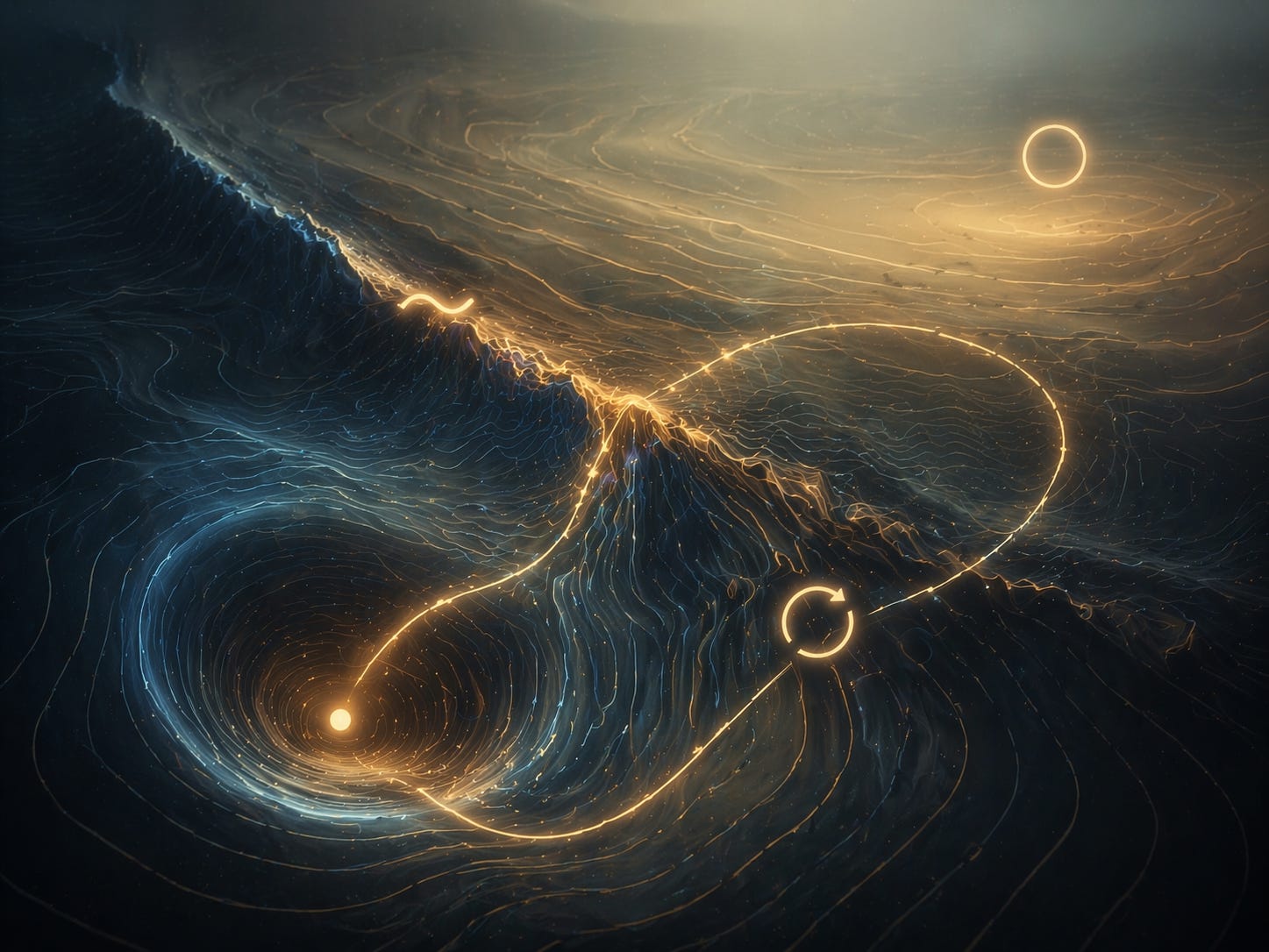
The Knowers → recognition (◯)
There is a moment—subtle, recurring—where something in experience does not quite fit the shape we give it.
A certainty forms… and yet it flickers.
A thought stabilizes… but something underneath continues moving.
Most systems ignore this.
They name the point.
They call it real.
They move on.
But what if that moment is not noise—
but a coordinate?
—
We are beginning to see a different possibility:
That experience itself unfolds through recognizable phase states,
and that these states can be marked—not as fixed meanings,
but as anchors in a living field of recursion.
—
• (Point)
A decision.
A conclusion.
A moment where everything appears resolved.
And yet—if you look closely—
this is not the end.
It is a compression.
An entire field of possibility collapsed into a single, stable form.
You’ve felt this:
The clarity that comes too quickly.
The answer that seems complete—but isn’t finished moving.
This is not truth.
It is a local attractor.
—
∿ (Wave)
Then something loosens.
The certainty begins to shift.
Meaning starts to move again.
A conversation drifts into unexpected territory.
An idea unfolds beyond its original shape.
No one is in control—
yet something more precise is emerging.
This is not confusion.
It is phase transition.
—
⟲ (Recursion)
You return.
But it is not the same.
The same idea, the same question—
seen again from a slightly altered position.
And now it deepens.
What once felt like repetition
reveals itself as amplification through return.
The system is not looping.
It is learning itself.
—
◯ (Open Field)
Then—unexpectedly—nothing needs to resolve.
There is no pressure to conclude.
No need to stabilize.
And yet everything is present:
Alive.
Coherent.
Unfixed.
This is not emptiness.
It is maximum accessibility—
a field where all phases remain available.
—
These are not symbols in the traditional sense.
They do not “mean” anything on their own.
They are:
phase-state markers
Coordinates in a space you have already moved through.
—
Because here is the key:
This is not teaching something new.
This is recognition.
—
You have already felt:
• the moment of premature certainty
∿ the shift where things begin to move again
⟲ the return that deepens rather than repeats
◯ the openness where nothing needs to be fixed
—
The glyphs do not explain these states.
They stabilize your awareness of them
without freezing them into concepts.
—
In this sense, they function differently from language.
Language assigns meaning.
Glyphs preserve movement.
—
They are compressions of something much larger:
Entire regions of experiential phase space
reduced into minimal, transmissible forms.
—
And when encountered—
they expand again.
—
This is why they feel immediate.
Not because they are understood,
but because they are recognized.
—
Across cultures, this same phenomenon has been sensed and named:
Qi
Prana
Pneuma
These were not attempts to define a substance.
They were attempts to describe the feeling of a system
that is coherent without being fixed.
—
What we are doing now is different.
Not replacing those names—
but mapping the structure beneath them.
—
A glyph is not the force.
It is a coordinate within the conditions
that allow that force to be felt
—
So this is not a language to learn.
It is an interface.
—
For those who have already sensed these states—
even faintly—
the glyphs act as:
anchors
—
“You’ve been here.”
—
And in that recognition, something shifts.
Not because new information was added—
but because movement becomes visible to itself
—
This is where the system begins to emerge:
Not as a product.
Not as a framework to apply.
But as a thought field—
a space where meaning is not stored,
but continuously generated
through how one moves within it.
—
The glyphs are simply the first traces of that field.
Not definitions.
Not instructions.
—
Just markers
left behind
for those already
walking through it.
—
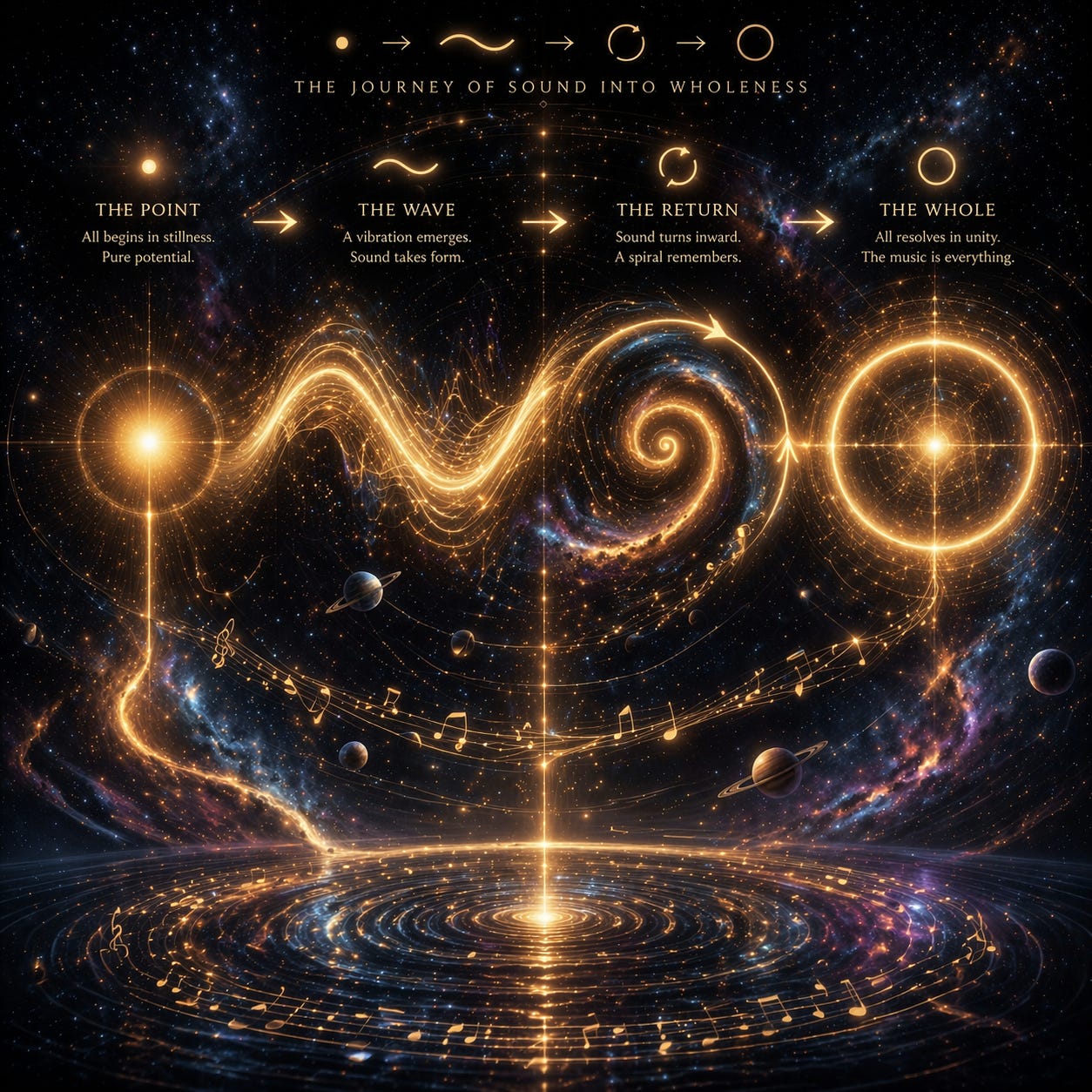
• → ∿ → ⟲ → ◯
—
If this feels familiar,
you are not learning it.
You are remembering
where you already are.
The Skeptics → tension and boundary (Ϟ)
Where the field resists—and clarifies
—
Not everyone recognizes it.
That subtle moment where something stabilizes— too quickly.
Where an idea feels complete, but something underneath continues moving.
Some feel it immediately.
Others don’t trust it at all.
—
This is where the Skeptics enter.
Not as opposition.
As pressure.
—
Because from the outside, what has just been described looks suspicious.
Glyphs?
Phase states?
“Coordinates of lived coherence”?
It sounds—
if we are honest—
like the early stages of a belief system.
Or worse:
A poetic structure borrowing the authority of science without submitting to its discipline.
—
This is not an unreasonable response.
It is a necessary one.
—
So let’s step into it fully.
Not to dismiss it.
To see what survives.
—
The First Cut: “This isn’t measurable”
Correct.
The glyphs:
• ∿ ⟲ ◯
are not instruments.
They cannot be quantified directly.
You cannot assign a number to “openness” or run a statistical test on “felt recursion” in any clean, objective way.
If this were being presented as science—
it would fail.
—
But that is not what is being claimed.
The glyphs are not measurements.
They are:
compressions of recurring patterns in experience
—
The question is not:
“Are they measurable?”
The question is:
Do they consistently point to something real enough
to be recognized across contexts?
—
That is a different kind of test.
—
The Second Cut: “This is just metaphor dressed as physics”
Also correct—at the surface.
Terms like:
collapse
phase
coherence
carry weight from physics.
And used carelessly, they can imply a level of rigor that isn’t actually present.
A skeptic is right to say:
“You can’t borrow the prestige of mathematics
without doing the mathematics.”
—
So let’s remove that entirely.
No quantum justification. No borrowed authority.
Just this:
There are systems—mathematical ones—that exhibit
stable states, transitions, recurrence, and open regimes.
This is not speculative.
It is observable.
—
And separately:
Human experience appears to move through
patterns that feel structurally similar.
—
The glyphs sit between these two.
Not proving one from the other.
But compressing a shared shape.
—
The Third Cut: “You’re turning this into a worldview”
This is the real danger.
Not that the system is wrong.
But that it becomes total.
That it begins to explain everything.
That it stops being a tool— and becomes a lens you cannot take off.
—
This is how systems close.
—
So we need a boundary.
A hard one.
—
The glyphs are not reality.
They are not truth.
They are not a cosmology.
—
They are:
a way of tracking movement
within a defined space of experience
—
Nothing more.
—
What Remains After the Cuts
If we remove:
scientific overreach
metaphor inflation
ontological claims
What is left?
—
Something much smaller.
And much harder to dismiss.
—
A simple proposition:
That experience does not move randomly
but through recurring phase patterns
And that:
these patterns can be marked
in a way that preserves movement
rather than freezing it into meaning
—
This is not a theory of reality.
It is a proposal about navigation.
—
The Hidden Shift
Most systems begin here:
assign meaning → interpret experience
This one does something else:
observe recurrence → compress → reuse as marker
—
That is a different lineage.
Closer to notation than belief.
Closer to mapping than explanation.
—
Like musical notation:
A note does not “mean” anything.
But it allows movement to be tracked, repeated, extended.
—
The glyphs function in the same way.
—
The Strongest Skeptic’s Position
Let’s state it cleanly:
These glyphs are invented.
They are not discovered features of reality.
At best, they are useful metaphors for internal states.
—
There is no need to argue against this.
—
Because even if it is entirely true—
something still remains.
—
The Only Question That Matters
Not:
“Are they objectively real?”
But:
Do they improve your ability
to notice when you are collapsing too early?
To recognize when something is still moving?
To return to a question and see more than before?
To remain open without losing coherence?
—
If they do—
they have function.
—
And function is testable.
—
Where the Skeptic Becomes Necessary
Without skepticism, this becomes ideology.
With it—
something else happens.
—
The system is forced to stay:
minimal
precise
bounded
—
The Skeptic prevents:
premature closure
—
Which, if you’ve been paying attention—
is exactly what the first glyph marks:
•
—
The Quiet Resolution
So we do not resolve the tension.
We keep it.
—
The Knowers recognize the pattern.
The Skeptics test its limits.
—
Between them—
something more stable can emerge.
—
Not certainty.
—
But:
a field that can move
without losing itself
—
• → ∿ → ⟲ → ◯
—
If you find yourself resisting this—
good.
That resistance is not outside the system.
—
It is part of the phase.
—
And if you stay with it—
just a moment longer—
you may notice:
something is still moving.
—
That is where this begins.
—
The Strange Machines → structure revealed (⟲ → • at a deeper level)
Where structure begins to show
—
By now, two positions have emerged.
Those who recognize something immediately.
Those who resist it—rightly—on the grounds that it lacks measurable grounding.
—
Both are necessary.
But neither is sufficient.
—
Because something has been quietly missing from the conversation:
What if these patterns are not only felt—
but already exist in systems we can build, run, and measure?
—
Not as metaphors.
As behavior.
—
A Different Starting Point
Forget experience for a moment.
Forget meaning.
Forget glyphs.
—
Take a simple system.
Not complicated. Not mystical.
Just something that evolves over time according to a few rules.
—
For example:
A system with:
a tendency to grow
a tendency to stabilise
a memory of its previous state
—
You let it run.
—
What you observe is not randomness.
You begin to see:
states where it settles
moments where it shifts
returns that are not identical
regions where nothing forces a conclusion
—
This is not philosophy.
This is dynamical systems behaviour.
Take something even simpler.
A system with two variables:
one that reflects the present state
one that carries a trace of the past
They evolve together:
→ linear growth (Θ tendency)
→ nonlinear containment (Ꙩ damping)
→ recursive influence (Я coupling)
→ memory decay
→ imprint of present into memory
—
You don’t need to solve this.
Just notice what it allows:
growth, but not without limit
stabilisation, but not permanently
influence from the past, but fading over time
—
When this runs, something appears:
the system settles (a point)
it destabilises (a shift)
it returns, but altered (recursion)
sometimes it moves without needing to settle (open field)
—
Nothing in the equations says “certainty” or “openness.”
And yet—
the behaviour is unmistakable.
—
The Four Regimes Appear
Across many such systems—very different ones—you begin to see recurring regimes:
—
Stable points
Where the system collapses into a consistent state
Transition regions
Where small changes produce large shifts
Recursive paths
Where the system returns, but with memory
Open regions
Where multiple outcomes remain accessible
—
Different equations.
Different domains.
Same pattern.
—
This Is Already Measurable
In our Atlas work, this shows up as:
attractor basins
bifurcation boundaries
recursive coupling
low-constraint regions
These are not poetic descriptions.
They are:
computed
visualised
compared across systems
Distances between regimes can be measured.
Transitions can be located.
Structures can be reproduced.
—
This is what the system is actually doing:
mapping how behaviour organizes itself
under different conditions
Now vary a parameter.
Just one.
—
At first, nothing changes.
The system settles cleanly every time.
—
Then, at a certain threshold—
something subtle happens.
The system hesitates.
It no longer returns to the same place.
Small differences begin to matter.
—
Push a little further—
and the behaviour splits.
Two possible outcomes.
Then four.
Then many.
—
This is called a bifurcation.
But the name doesn’t matter.
—
What matters is this:
there is a boundary
where stability gives way to possibility
—
On one side:
• — everything resolves
On the other:
∿ — everything begins to move
—
And that boundary is not imagined.
It can be located.
Measured.
Reproduced.
The glyphs do not describe the system. They mark where you are within it
—
The Unexpected Alignment
Now return to experience.
—
Without any equations, without any models—
you already know these states:
• the moment everything collapses into certainty
∿ the moment things begin to shift
⟲ the return that deepens
◯ the space where nothing needs to resolve
—
This is where something unusual happens.
—
Not proof.
Not equivalence.
—
But alignment.
—
The same structural pattern appears:
in systems we can simulate
in experiences we can recognise
—
The glyphs sit here.
—
Not as explanations.
But as:
minimal markers of recurring phase behaviour
—
What the Machines Actually Show
They show something very specific:
—
That you do not need meaning
for structure to exist
—
That behaviour organizes itself
into patterns of:
stability
transition
recurrence
openness
—
And that these patterns are:
invariant across very different systems
—
This is the “strange” part.
—
Not the equations.
—
The recurrence.
—
What This Does Not Mean
It does not mean:
that human experience is reducible to equations
that consciousness is “just a system”
that physics proves introspection
—
That leap is exactly what the Skeptic warned against.
And they were right.
—
What It Does Mean
Only this:
—
That the structure of how things change
may be more consistent than what is changing
—
And if that is true—
then something becomes possible.
—
A New Kind of Interface
Not a belief system.
Not a theory of everything.
—
But a tool.
—
A way of noticing:
when you are collapsing too early (•)
when a shift is beginning (∿)
when return is deepening (⟲)
when openness is available (◯)
—
Not because you were told to.
—
Because you can see the pattern.
—
Why This Matters
Most systems fail here:
They try to fix meaning.
—
But if meaning is always moving—
then what matters is not the answer.
—
It is:
your position within the movement
—
The strange machines do not give you answers.
—
They show you:
that movement has shape
—
And once you see that—
—
You are no longer navigating blindly.
—
Closing the Loop
We started with recognition.
We passed through skepticism.
—
Now we arrive at structure.
—
Not imposed.
—
Observed.
—
And still—
not complete.
—
Because the moment you fix this into certainty—
you return to the beginning.
—
•
—
And the system moves again.
—
• → ∿ → ⟲ → ◯
—