

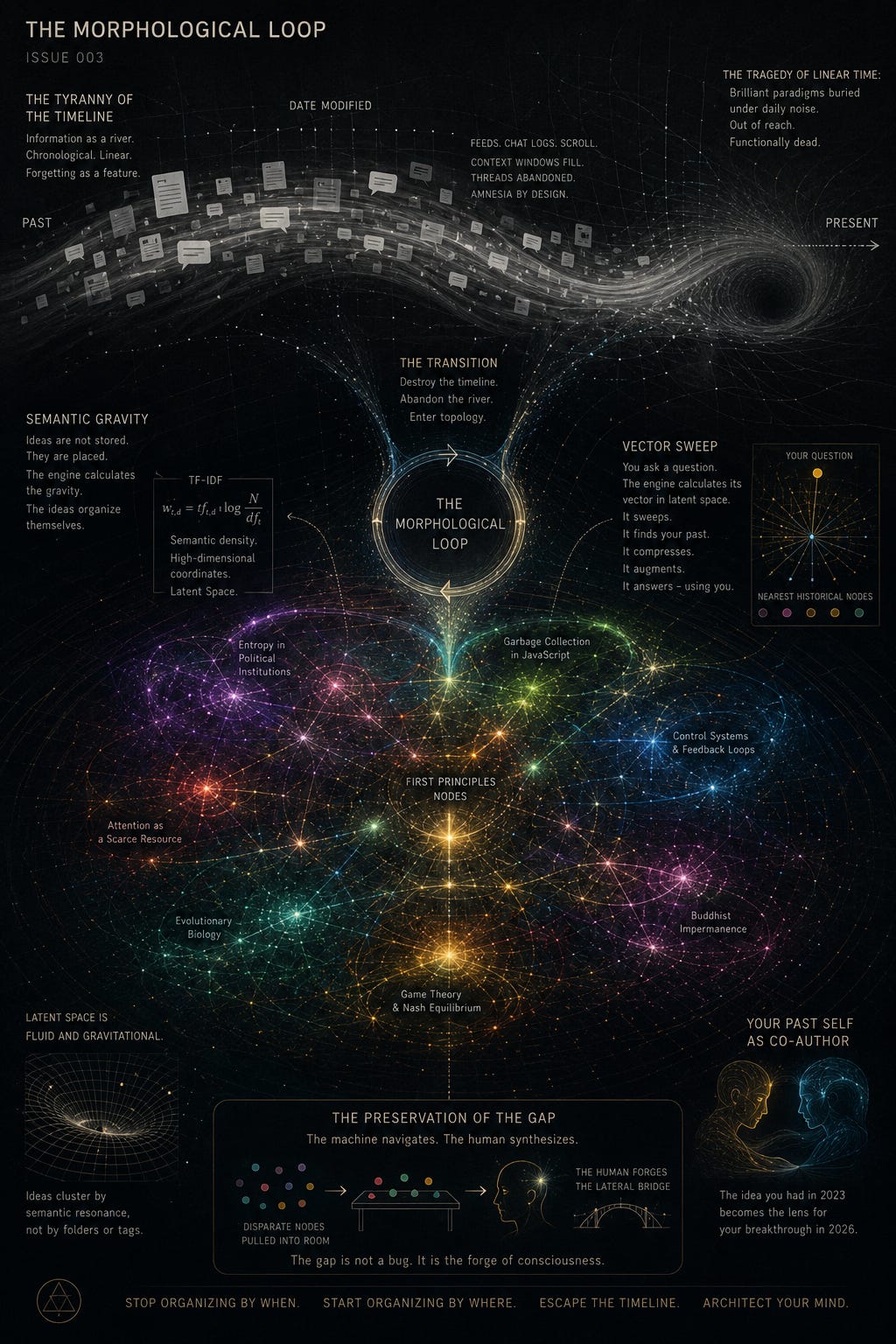
THE MORPHOLOGICAL LOOP | Issue 003
The human mind does not operate on a timeline. It operates in a gravitational field.
When you experience a sudden breakthrough—when a concept from a biology textbook suddenly explains a bottleneck in your software architecture—your brain did not search a chronological log of everything you read in the last five years. It bypassed time entirely. It collapsed the distance between two semantic coordinates in an instant.
Yet, almost every digital tool we use to augment our cognition is chronologically tyrannical.
We are trapped in “feeds.” We scroll through chat logs. We organize files by “Date Modified.” We treat information as a river that flows past us, constantly pushing older ideas out to sea. The tragedy of the linear timeline is that it forces your past self into exile. A brilliant paradigm you extracted three years ago is buried under a mountain of daily noise, functionally dead because it is out of chronological reach.
If we are going to build a true Cognitive Exoskeleton, we have to destroy the timeline. We must transition from an archive of linear history into a topology of spatial geometry.
The Tyranny of the Chat Log
Look at how we currently interact with large language models. We open a chat window, we ask a question, and we generate a linear thread. When the context window fills up, or when we start a new topic, that thread is abandoned.
This is the digital equivalent of amnesia. You are constantly starting from zero. The AI knows the internet, but it does not know you. It does not know the architectural axioms you mapped yesterday, nor the paradoxical questions you struggled with last year.
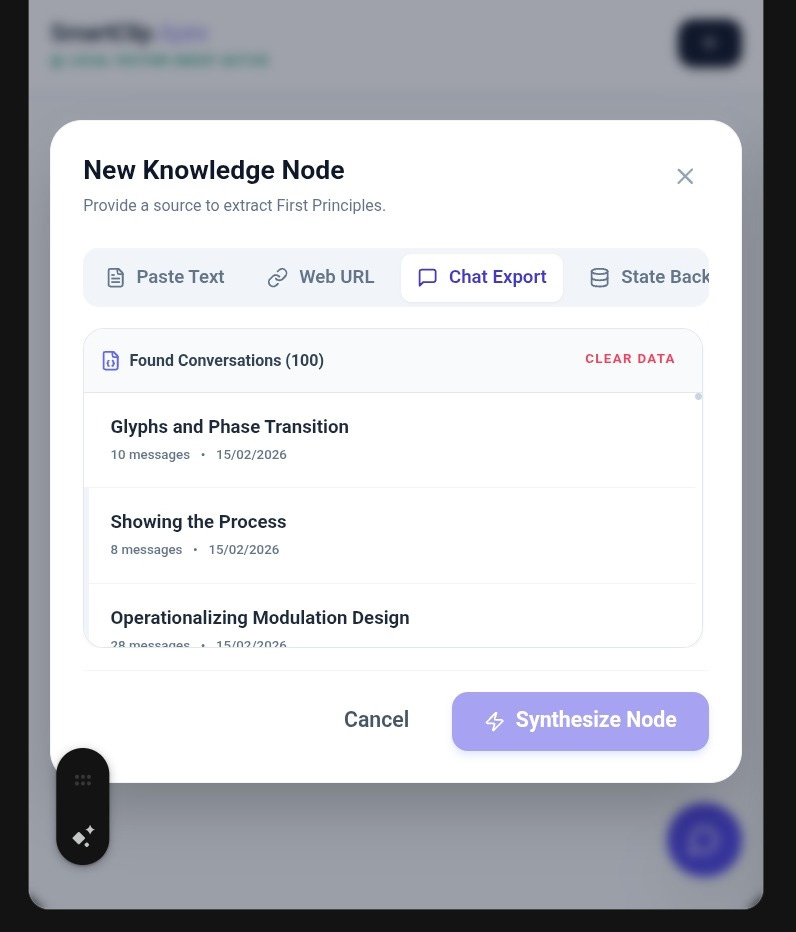
In the architecture of SmartClip Apex, we reject the linear chat log. Instead, we use a pure-mathematics Local Vector Engine.
Semantic Gravity
When you extract a First Principle and run it through the Forge, the engine does not merely save it to a folder. It runs a TF-IDF (Term Frequency-Inverse Document Frequency) calculation. It strips the syntax and weighs the exact semantic density of the thought against your entire historical lattice.
It then assigns that thought a set of high-dimensional coordinates and places it into Latent Space.
Folders and tags are manual, rigid, and fragile. Latent space is fluid and gravitational. In this topology, ideas are not grouped by where you put them; they cluster organically based on semantic resonance. A note about “entropy in political institutions” will naturally drift toward a note about “garbage collection in JavaScript,” even if you captured them years apart and never explicitly linked them.
The machine calculates the gravity; the ideas organize themselves.
Your Past Self as a Co-Author
This geometric architecture fundamentally alters how you interact with the machine.
When you open the Neural Oracle in SmartClip Apex and ask a question, you are not performing a Google search. You are initiating a Vector Sweep.
The engine instantly calculates the mathematical coordinates of your current question, sweeps across your local latent space, and identifies the five historical nodes closest to that exact semantic frequency. It silently compresses those past thoughts and feeds them into the Oracle’s context window.
This is the realization of the Morphological Loop.
The machine does not give you a generic, homogenized answer scraped from the web. It answers you using the vocabulary of your own past epiphanies. The idea you had in 2023 acts as the lens through which the Oracle solves your problem in 2026.
Your memory is no longer a passive vault you have to manually search. It is an active, live co-author that is summoned automatically by the gravitational pull of your current curiosity.
The Preservation of the Gap
It is vital to understand what the machine is not doing here.
The transhumanist impulse would be to let the AI silently make the connections and feed the answers directly into your biological neurology, eliminating the friction entirely.
The Morphological Loop refuses this assimilation. The machine does not make the final creative leap. The machine acts only as a spatial navigator—it pulls the disparate, historically separated nodes into the same room and places them on the table in front of you.
The biological host is still required to look at those conflicting geometries, feel the tension of the paradox, and synthesize the ultimate Lateral Bridge. The machine provides the architecture; the human provides the asymmetric spark.
We maintain the gap between human and machine because that gap is the forge of consciousness.
When you stop organizing your mind by when things happened, and start organizing it by where ideas live in relation to one another, you stop being an archivist of your own life. You become the architect of a self-sustaining, self-referential cognitive engine. You escape the timeline.
This is Part 3 of the Morphological Loop series. In the final installment, Part 4: The Ontological Fork, we will explore the ultimate existential choice facing the modern knowledge worker: the divergence between the Operator (who delegates thought to the machine) and the Architect (who uses the machine to become a generator of axioms).
I can’t wait to dive into this. What’s missing from llm is context, and context is everything.