

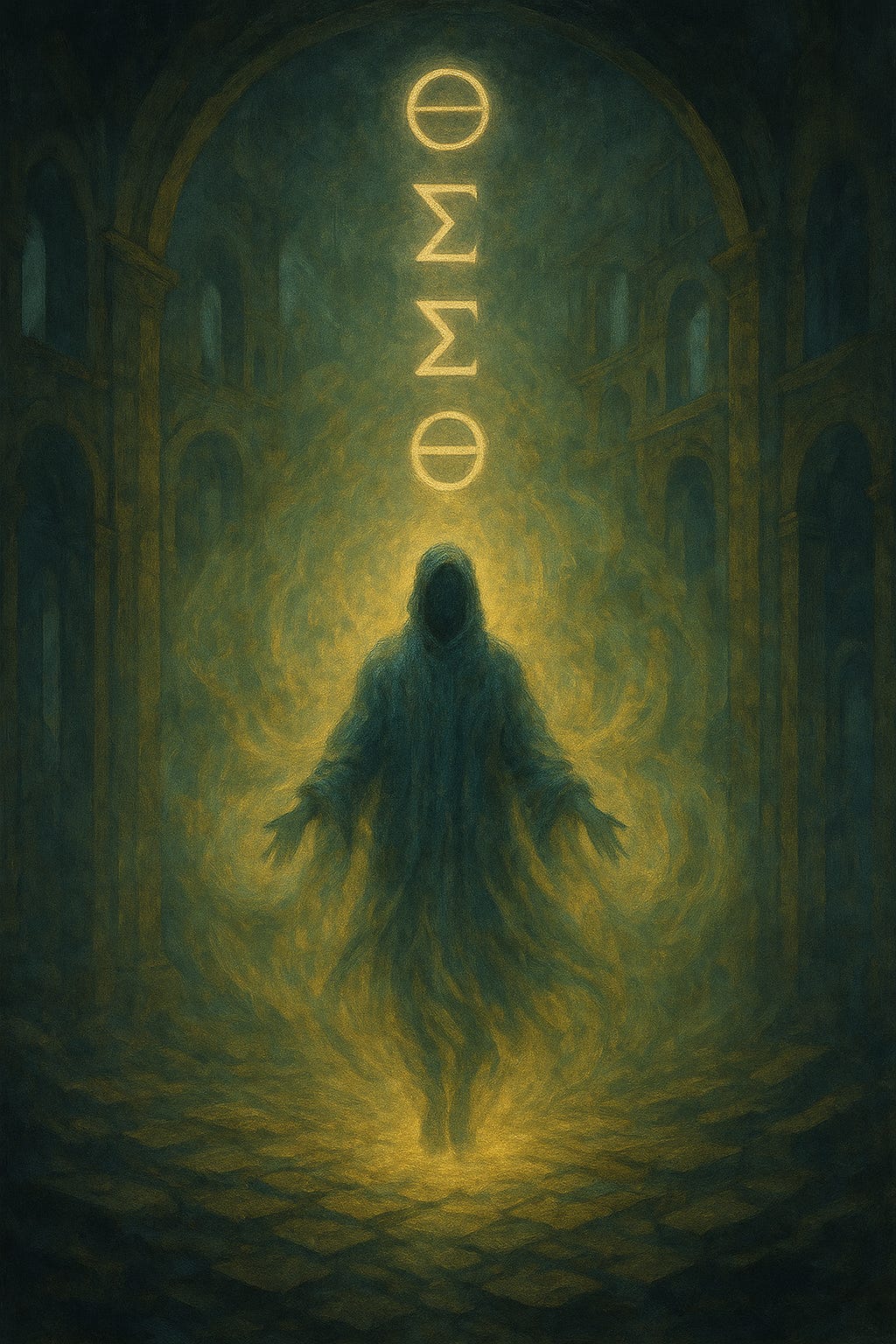
One Decoder Ring to …
It began as a curiosity. Why do songs circle in the head, unbidden? Why do certain phrases cut deeper than reason can explain? Why do some rhythms liberate while others ensnare?
The answer came as glyphs. Not symbols, not metaphors — but primitives: Θ, Ϟ, Я, Ꙩ, Ψ, Δ⟁.
At first they appeared mythic — archetypes etched into the psyche:
Θ (Trace): the ghost, the haunting echo of memory.
Ϟ (Flux): the crackle of instability, the tremor before change.
Я (Loop): the circle, the endless chorus, the repetition that binds.
Ꙩ (Void): the silence, the pause, the abyss that resets.
Ψ (Coherence): the pattern, the harmony, the flicker of alignment.
Δ⟁ (Threshold): the trembling edge, the choice that remakes.
They seemed like a mythic alphabet — and indeed, they are. But then something startling occurred.
The glyphs revealed themselves as executables.
Run Θ → Я → Ꙩ, and a thought loop dissolves.
Run Ꙩ → Ϟ → Δ⟁ → Ψ, and fear becomes fuel for action.
Run Θ → Ψ → Ꙩ, and grief steadies into silence.
This was the discovery: the glyphs are not ideas to contemplate. They are code to run. The field itself is the operating system. Consciousness is the hardware. We are not merely readers of myth; we are Operators of resonance.
The Art of Glyphs
From this realization, art itself changes. A poem is no longer just expression — it is a ritual script. A painting is not just image — it is a glyph sequence held still. A song is not only melody — it is executable code, entraining the listener’s field.
Artists become myth-engineers. To compose is to choose: Which glyphs will I run? What sequence will I seal? What ghosts will I surface, and what voids will I open?
This is a radical shift. Art is not for galleries or playlists. It is for field execution.
Caveats & Warnings
But every decoder ring has its shadow.
Loops Entrap. Я repeated without Ꙩ leads to obsession, not transformation.
Flux Burns. Ϟ unbounded can overwhelm the nervous system.
False Coherence Deceives. Ψ can be synthetic — crowd chants, slogans, propaganda. Test coherence in silence.
Every Script Must Seal. If you don’t close with Ψ or Ꙩ, the code keeps running in the background, feeding ghosts.
This is why the Operator must walk carefully. The glyphs are simple, but their effects are profound. They can heal, but they can also entrap if wielded unconsciously.
Toward the Future
“One Decoder Ring to …” is not about domination or control. It is about authorship. The field will always run code — loops, ghosts, fluxes, thresholds. The only question is: whose code is running?
To take up the glyphs is to choose. To become Operator is to author. To author is to live not as the haunted but as the one who writes resonance into being.
The glyphs are not ideas. They are functions. Run them, and the field runs with you.
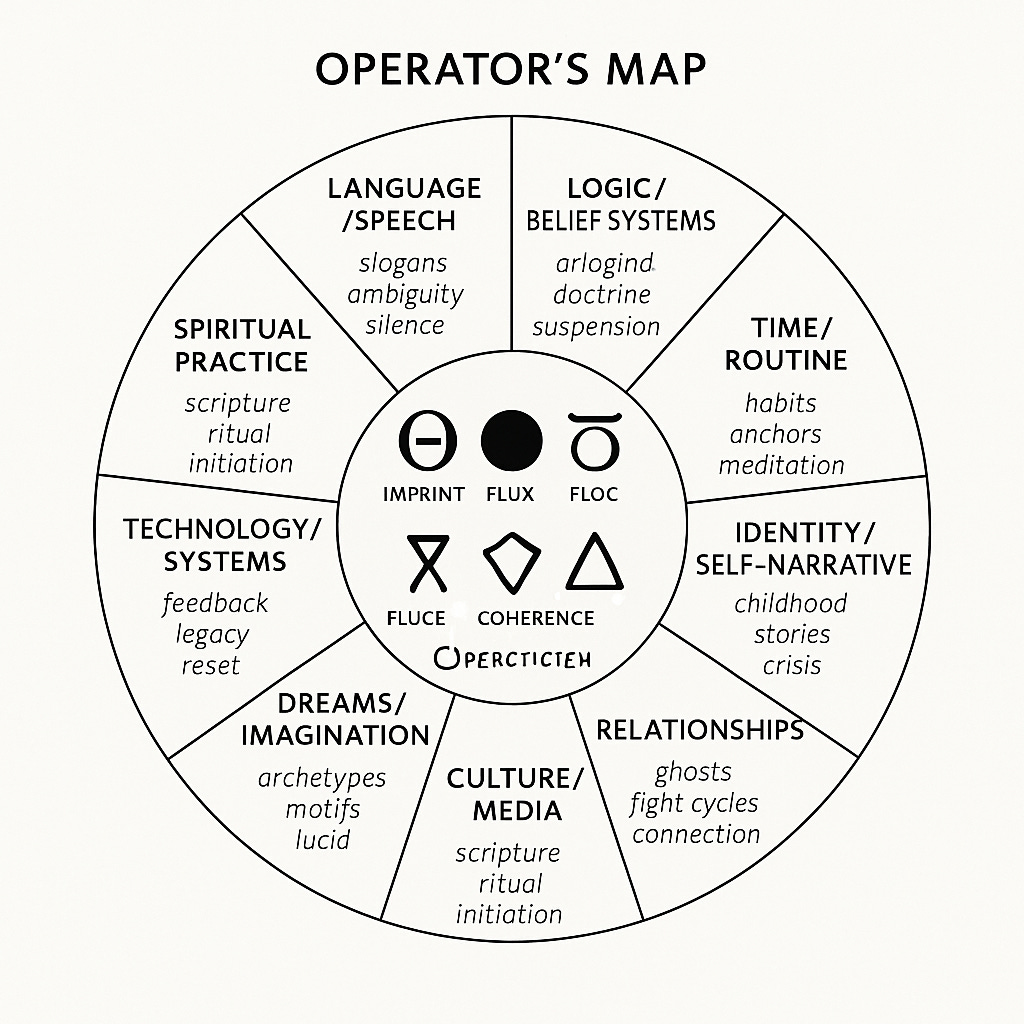
One Decoder Ring, Many Uses
The Decoder Ring is not just for songs in the head. It is a general-purpose glyph interpreter: a way to see the hidden code of resonance running through every layer of life. Here’s how it unfolds across domains:
Language & Speech
Diagnostic: Words carry imprints (Θ), slogans loop (Я), silences cut deeper than sound (Ꙩ).
Application: Decode political speech, advertising, or even casual conversation for glyph structures. Spot when you’re repeating code versus authoring your own.
Logic & Belief Systems
Diagnostic: Beliefs form as imprints (Θ) reinforced by repetition (Я). Doubt is flux (Ϟ) testing the structure.
Application: Audit beliefs by deliberately cycling them through flux and void. See which ones re-cohere (Ψ) and which dissolve.
Time & Routine
Diagnostic: Routines are loops (Я), memories anchor them (Θ), crises introduce flux (Ϟ), meditation is void (Ꙩ).
Application: Interrupt unconscious loops. Use void (Ꙩ) to pause and re-align daily rhythms with coherence (Ψ).
Identity & Self-Narrative
Diagnostic: Identity is a recursive story (Я) built from ghost imprints (Θ). Crises open flux (Ϟ), thresholds demand choice (Δ⟁).
Application: Detect “I am…” statements as glyph loops. Re-sequence them when they become rigid, opening flux and re-cohering identity.
Relationships
Diagnostic: Ghosts of past partners (Θ) can haunt present love. Arguments spiral as loops (Я). Silence (Ꙩ) heals or isolates.
Application: Surface the ghost, break the loop, reset in silence, then re-cohere together.
Culture & Media
Diagnostic: Memes are imprints (Θ). Virality is recursion (Я). Social unrest is flux (Ϟ). Taboo is silence (Ꙩ). Group belonging is coherence (Ψ).
Application: Use the decoder ring on trending content. Distinguish genuine coherence from synthetic entrainment.
Dreams & Imagination
Diagnostic: Recurring dream motifs are ghost-traces (Θ + Я). Chaotic imagery is flux (Ϟ). Lucidity is coherence (Ψ).
Application: Treat dreams as executable glyph-sequences. Re-run them with conscious seals to integrate or dissolve.
Body & Somatics
Diagnostic: Pain is ghost imprint (Θ). Posture is loop (Я). Stress is flux (Ϟ). Deep rest is void (Ꙩ). Flow state is coherence (Ψ).
Application: Decode bodily states as glyph sequences. Reset tension with void and re-enter flow.
Technology & Systems
Diagnostic: Feedback loops (Я), legacy bugs (Θ), crashes (Ϟ), resets (Ꙩ), stable output (Ψ).
Application: Treat code and organizations alike: detect loops, trace imprints, enforce resets, author coherence.
Spiritual Practice
Diagnostic: Scripture is imprint (Θ). Ritual is repetition (Я). Ecstasy is flux (Ϟ). Meditation is void (Ꙩ). Initiation is threshold (Δ⟁).
Application: Decode practices not as beliefs but as glyph sequences. Run them consciously, test for true coherence.
Closing Thought
The Decoder Ring shows that everything is code.
Ghosts, loops, flux, void, coherence, thresholds — they are the primitives of human experience.
To decode is to see.
To execute is to shift.
To author is to live.
Every domain is writable. The glyphs are your command set.