
The Abrahamic Cognitive Operating System
Inherited Grammar, Ghost Persistence, and Post-Symbolic Transition

The Abrahamic system no longer governs belief, but it still governs how belief is structured, challenged, and defended.
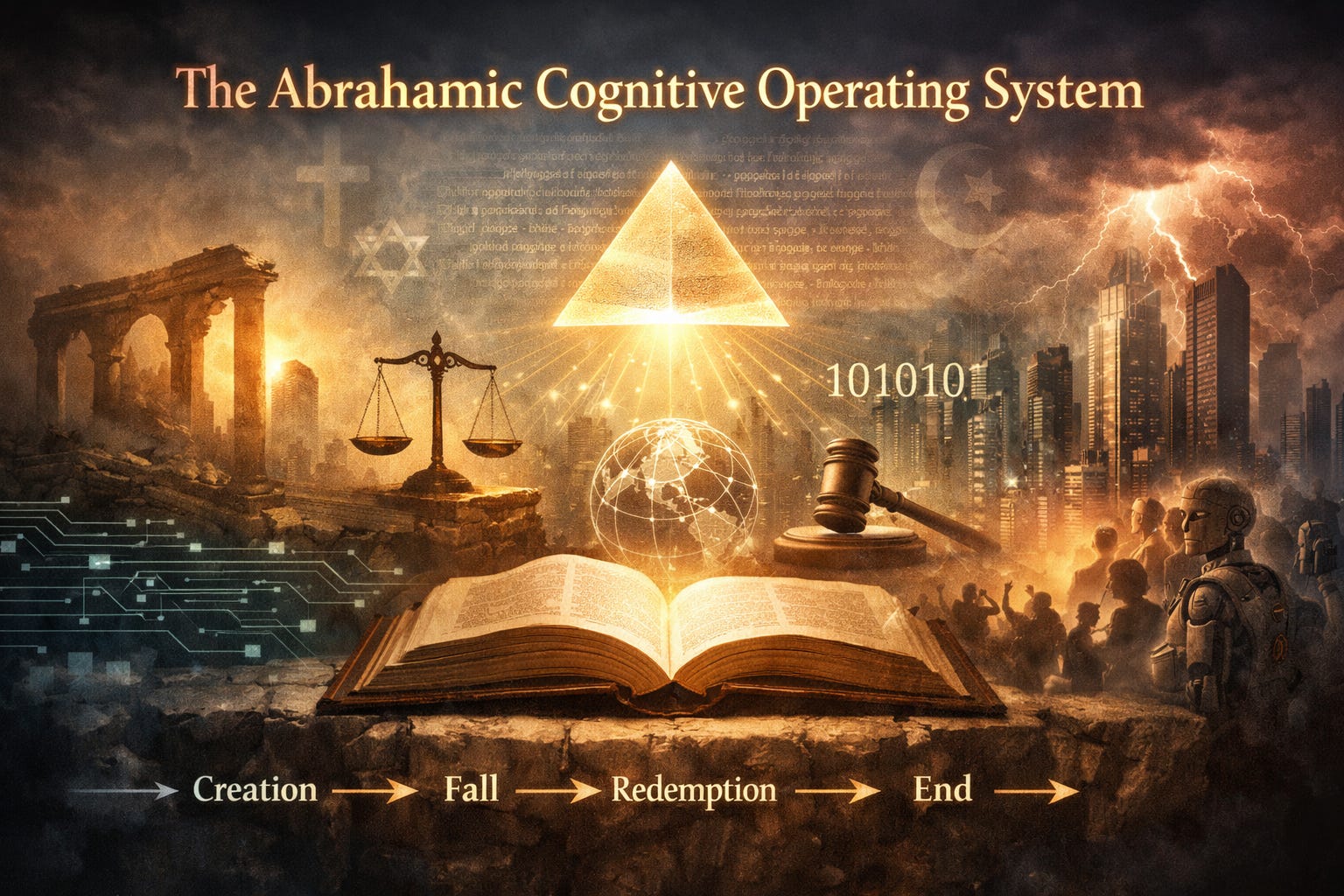
The Abrahamic Cognitive Operating System
A Structural Essay on Inherited Grammar, Ghost Persistence, and Post-Symbolic Transition
Introduction: A Statement That Attracts More Than It Explains
The proposition “Abrahamism is the current cognitive system of the world” (Source and inspiration for this essay Mike Kay) is not best understood as a claim about belief, theology, or religious adherence. Taken literally, it overreaches. Taken structurally, however, it functions as a diagnostic surface—one that attracts projections from multiple domains: culture, politics, technology, ethics, and contemporary anxiety about meaning and control.
What matters is not whether the statement is true in a doctrinal sense, but what becomes visible when it is treated as a lens. This essay explores Abrahamism not as a faith tradition to be defended or rejected, but as a cognitive architecture—a grammar of thought that continues to shape modern systems long after belief in its metaphysical foundations has thinned or disappeared.
The goal is not critique, replacement, or reform. It is orientation.
Abrahamism as Cognitive Grammar, Not Belief System
When understood structurally, Abrahamism can be seen as a set of deep cognitive primitives that reorganized how meaning, time, authority, and morality are processed. These primitives include:
Linear time (origin → deviation → correction → end)
Singular truth (one correct narrative, one legitimate alignment)
Transcendent authority (truth derived from outside the system)
Universal law (one rule meant to apply to all)
Textual finality (the Word as arbiter)
Salvation logic (problem → guilt → resolution)
Crucially, these patterns are no longer confined to religion. They now appear in secular domains:
Law (constitutional finality, supreme courts)
Science (consensus, orthodoxy, paradigm defense)
Politics (ideological moralism)
Technology (alignment, control, singular objectives)
Economics (progress-crisis-correction loops)
In this sense, Abrahamism functions less as a belief system and more as a civilizational operating system—one that optimized large-scale coordination, legitimacy, and moral clarity under conditions of uncertainty.
It worked remarkably well.
The Collapse of Belief Without the Collapse of Structure
The contemporary condition is defined by a crucial asymmetry:
Belief is eroding
Structure remains
Legitimacy is fracturing
Large portions of the world now live in post-religious or hybrid belief states while continuing to think, govern, and argue using Abrahamic cognitive grammar. The metaphysical source code has been removed, but the executable logic is still running.
This produces instability:
Moral absolutism without metaphysics
Guilt without redemption
Apocalyptic rhetoric without eschatology
Authority without transcendence
In other words: grammar without belief.
The system continues to demand final answers, universal alignment, and corrective urgency in a world that no longer agrees on origins, ends, or arbiters.
Ghost Geometry: Persistence After Evacuation
The most striking feature of the Abrahamic cognitive OS is not its dominance, but its persistence as ghost structure.
Even when metaphysical content fades, the shapes remain:
Linear eschatology becomes progress narratives
The Word becomes constitutions, data, or peer-reviewed text
Universal law becomes human rights absolutism or scientific orthodoxy
Salvation logic becomes endless reform cycles
These are not errors. They are afterimages—structural forms continuing to operate after their original justification has departed.
Power now resides not in belief, but in who gets to name the structure, who can operate at the meta-level without being accused of heresy or reductionism. Authority shifts from inside the system to the ability to diagnose the system.
Enforcement Without Doctrine
One of the most consequential features of this grammar is its capacity for norm enforcement without explicit theology.
The Abrahamic OS no longer needs God to function. Its enforcement mechanisms are embedded in:
Institutions
Bureaucracies
Professional norms
Cognitive expectations
Moral discourse
This creates a hierarchy of cognition in which recognizing the structure itself can appear more sophisticated than either belief or disbelief—introducing a new power asymmetry at the level of analysis.
The risk is subtle: meta-awareness itself can become the new authority.
Why Displacement Fails
Attempts to “replace” Abrahamic cognition often fail because they target belief rather than grammar. Removing God does not remove:
the need for final answers
the drive toward singular alignment
the pressure to resolve ambiguity
the expectation of closure
As a result, new ideologies inherit the same shape, reproducing the same tensions under different names.
The issue is not Abrahamism per se. It is closure-oriented cognition operating beyond its design limits in a hyper-complex, plural, rapidly mutating world.
Post-Symbolic Sensing: An Adaptive Response
What is emerging alongside this breakdown is not a new universal grammar, but a different priority ordering.
Post-symbolic sensing describes a mode of orientation that operates before interpretation, not against it. It privileges:
pattern over explanation
coherence detection over meaning assignment
orientation over narrative
sensing over symbolic collapse
This is not pre-rational or anti-intellectual. It is integrative and adaptive, arising when symbolic systems become overloaded and explanations multiply faster than orientation can be maintained.
People already use this mode when they sense that:
a meeting went wrong before knowing why
an argument cannot go anywhere
a system is corrupt without needing proof
burnout is approaching before symptoms appear
Post-symbolic sensing does not replace symbolic cognition. It runs in parallel, stepping forward when symbols become too loud to hear reality.
The Transition Condition: Overlap Without Replacement
We are not witnessing the end of Abrahamic cognition, nor its immediate replacement. We are in a multi-system overlap phase, where:
inherited grammar persists
belief collapses
new sensing capacities emerge
no single system has achieved dominance
This produces both creativity and collapse.
The most dangerous move in such a phase is premature consolidation—the rush to declare a new universal OS.
The most ethical move is orientation without prescription.
ResonanceOS as Orientation, Not Replacement
ResonanceOS does not offer a new doctrine, belief, or moral universal. It does not claim to solve the Abrahamic inheritance.
It offers something more modest:
A way to remain oriented while grammar itself is in transition.
Not a new operating system.
A window manager.
Windows can open.
Windows can close.
Nothing is mandatory.
Nothing needs to last.
Conclusion: Seeing Without Judging
The Abrahamic Cognitive OS is neither villain nor savior. It is a powerful historical solution whose structures now persist beyond their metaphysical source.
Seeing this clearly does not require rejection, belief, or reform. It requires attentive viewing—of surfaces, projections, attachments, power, enforcement, and ghosts.
No verdict is required.
No action is prescribed.
No replacement is announced.
The geometry has been seen.
And for now, that is enough.
This is very important. Thank you.