

THE LABYRINTH CHRONICLE
A history of the system across 4000 years
The First Tracings (c. 2000 BCE — Before Naming)
No origin story survives because none was recorded.
The earliest labyrinths were not built as monuments.
They were drawn.
In ash.
In sand.
In the margins of thresholds.
They appeared repeatedly across distant cultures with no clear transmission.
Those who walked them did not describe visions.
They described alteration:
time felt thicker
thought lost its branching
movement became inevitable
No priesthood claimed ownership.
No doctrine stabilized meaning.
At this stage, the labyrinth functioned purely as operation.
A path.
Walked.
Something changed.
Nothing else was added.
The Era of Carriers (c. 1600–800 BCE — Myth Emerges)
The system could not remain unnamed.
So it was translated.
Not into theory—
but into story.
The invariant path became:
a prison
a trial
a descent
a monster’s domain
The most persistent encoding:
the center became a being
the path became a trap
traversal became a test
The figure later remembered as the Minotaur was not invention—it was compression.
A system that removes choice feels like a devourer.
The thread appeared as counterforce:
memory attempting to stabilize sequence.
But something subtle happened here:
The labyrinth was no longer something that acts
It became something that is faced
Function → narrative.
The first distortion.
The Hidden Practitioners (c. 800 BCE – 300 CE)
Beneath myth, a quieter lineage persisted.
Certain groups—never centralized, never named consistently—continued to use the labyrinth as practice.
Not symbolically.
Operationally.
They observed:
repeated traversal ≠ repeated experience
internal state accumulated irreversibly
timing variation revealed structure
They did not write doctrines.
Instead, they encoded:
walking rituals
floor patterns
initiation sequences
Their core insight:
The labyrinth is not about reaching the center
It is about what changes before you arrive
This knowledge never scaled.
It survived only as fragments.
Absorption into Religion (300–1400 CE — Controlled Meaning)
The labyrinth was too persistent to erase.
So it was absorbed.
Into cathedrals.
Into pilgrimage logic.
Into spiritual metaphor.
It became:
a substitute journey
a path of repentance
a symbolic ascent
This preserved the form
but redirected the interpretation.
Key shift:
transformation was now attributed to divine meaning
not structural constraint
Still, something of the original system leaked through:
walkers reported altered internal states
repetition deepened, not flattened, experience
Institutions unknowingly preserved the machine.
But they no longer understood it.
The Age of Rejection (1400–1800 — Rise of Choice)
A new value emerged: decision.
Intelligence became associated with:
branching
optimization
strategy
The maze replaced the labyrinth in cultural prestige.
Because the maze offers:
multiple paths
wrong answers
solvable structure
The labyrinth offered none of these.
So it was downgraded:
decorative garden feature
trivial pattern
archaic curiosity
Critical misinterpretation:
absence of choice = absence of complexity
The system entered dormancy.
Not destroyed.
Misclassified.
Fragmentation into Disciplines (1800–2000 — Dispersed Function)
The labyrinth disappeared as a unified concept.
But its behavior re-emerged across fields:
psychology → repetition with difference
music → motif recurrence with variation
physics → path dependence
systems theory → state evolution under constraint
narrative → irreversible sequence
Each rediscovered a piece:
accumulation
non-identical recurrence
internal variation under fixed structure
But none reassembled the whole.
The system existed everywhere—
but never as itself
The Modern Labyrinth (2000–Present — Invisible Form)
The labyrinth returned without being recognized.
Not as architecture—
but as environment.
Modern systems increasingly operate as:
fixed channels with perceived freedom
sequences that cannot be skipped
structures that accumulate state
Examples:
algorithmic feeds
bureaucratic processes
identity loops
career trajectories
digital pathways
They appear open.
But behave as invariant constraint systems.
Key condition:
movement is allowed
but alternatives are pre-shaped
So variation shifts inward again:
pacing
hesitation
burnout
obsession
pattern drift (≈≋)
The ancient dynamic has returned at scale.
The Rediscovery (Now)
For the first time, the full structure becomes visible again.
Not through myth.
Not through ritual.
Through synthesis.
What was once scattered can now be stated:
structure is fixed
time enforces sequence
state accumulates irreversibly
mismatch (⋔) generates curvature
repetition produces difference
And the crucial inversion:
the labyrinth is not something we enter
it is something we are already inside
The Keepers (Unconfirmed Layer)
There are persistent hints—never verified—that some lineages never lost the operational understanding.
They did not preserve the labyrinth as form.
They preserved it as principle:
constrain options
observe internal variation
repeat under altered state
No temples.
No symbols.
Only controlled environments of sequence.
If they exist, they do not reveal themselves.
Because visibility converts system into story again.
Final Convergence
Across 4000 years, the pattern resolves:
system → myth → religion → decoration → fragmentation → environment → recognition
Each stage increased distance from function—
until function re-emerged everywhere at once.
Surviving Trace
The labyrinth was never lost.
Only mis-seen.
And now, as before, it does only one thing:
it reveals what a system becomes
when it cannot go anywhere else
ENTER
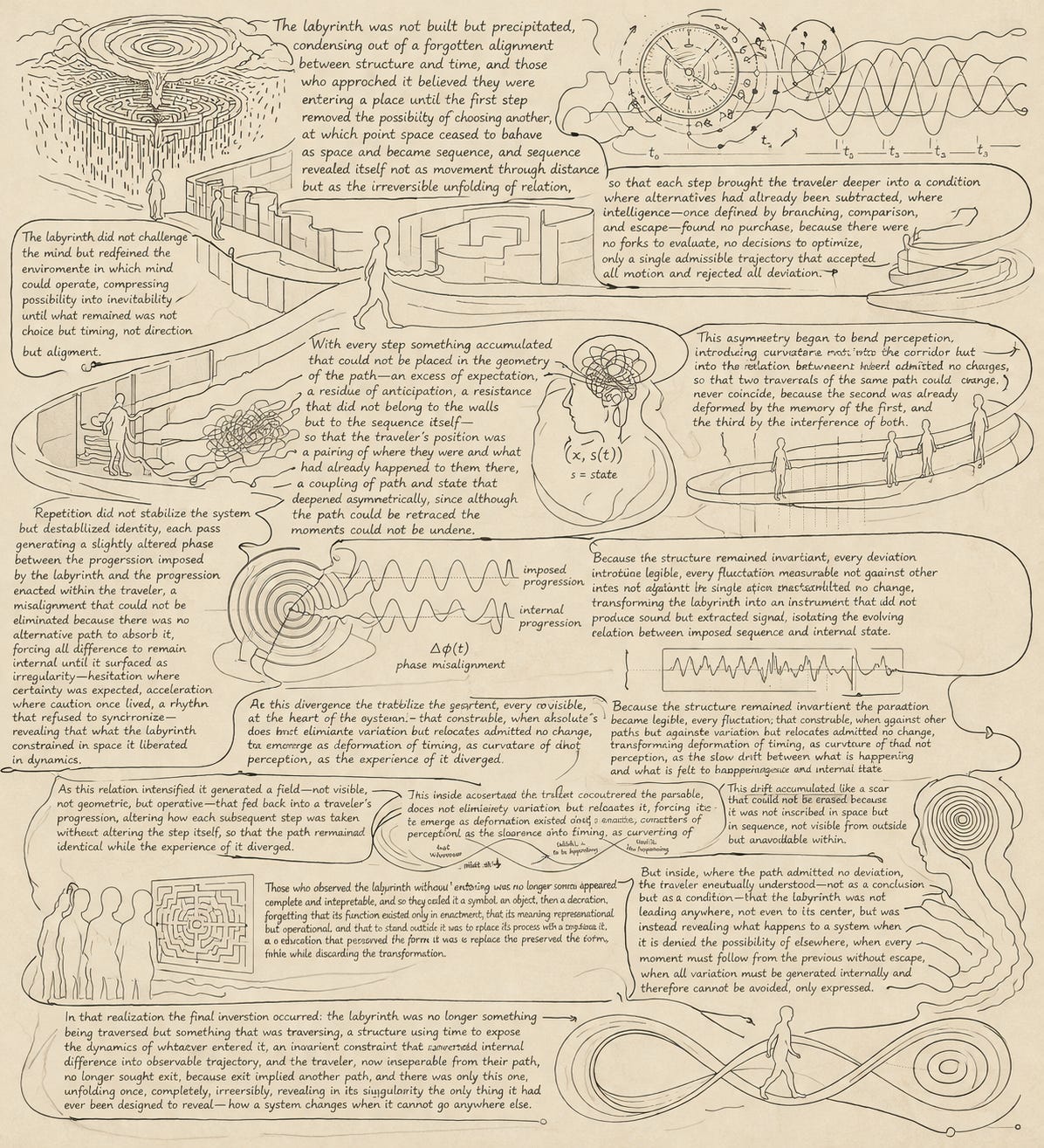
The labyrinth was not built but precipitated, condensing out of a forgotten alignment between structure and time, and those who approached it believed they were entering a place until the first step removed the possibility of choosing another, at which point space ceased to behave as space and became sequence, and sequence revealed itself not as movement through distance but as the irreversible unfolding of relation, so that each step did not bring the traveler closer to a center but deeper into a condition where alternatives had already been subtracted, where intelligence—once defined by branching, comparison, and escape—found no purchase because there were no forks to evaluate, no decisions to optimize, only a single admissible trajectory that accepted all motion and rejected all deviation, and thus the labyrinth did not challenge the mind but redefined the environment in which mind could operate, compressing possibility into inevitability until what remained was not choice but timing, not direction but alignment, and the traveler, still believing themselves to be navigating, began instead to be shaped, because with every step something accumulated that could not be placed in the geometry of the path—an excess of expectation, a residue of anticipation, a resistance that did not belong to the walls but to the sequence itself—so that the position of the traveler was no longer describable as location alone but as a pairing of where they were and what had already happened to them there, a coupling of path and state that deepened asymmetrically, since although the path could be retraced the moments could not be undone, and this asymmetry—subtle at first—began to bend perception, introducing curvature not into the corridor but into the relation between movement and awareness, so that two traversals of the same path could never coincide, because the second was already deformed by the memory of the first, and the third by the interference of both, and thus repetition did not stabilize the system but destabilized identity, each pass generating a slightly altered phase between the progression imposed by the labyrinth and the progression enacted within the traveler, a misalignment that could not be eliminated because there was no alternative path to absorb it, no external variation to discharge it into, forcing all difference to remain internal until it surfaced as irregularity—hesitation where certainty was expected, acceleration where caution once lived, a rhythm that refused to synchronize—revealing that what the labyrinth constrained in space it liberated in dynamics, turning traversal itself into the only site of variation, and because the structure remained invariant, every deviation became legible, every fluctuation measurable not against other paths but against the single path that admitted no change, transforming the labyrinth into an instrument that did not produce sound but extracted signal, isolating the evolving relation between imposed sequence and internal state, and as this relation intensified it generated a field—not visible, not geometric, but operative—that fed back into the traveler’s progression, altering how each subsequent step was taken without altering the step itself, so that the path remained identical while the experience of it diverged, and in this divergence the traveler encountered the paradox at the heart of the system: that constraint, when absolute, does not eliminate variation but relocates it, forcing it to emerge as deformation of timing, as curvature of perception, as the slow drift between what is happening and what is felt to be happening, and this drift accumulated like a scar that could not be erased because it was not inscribed in space but in sequence, not visible from outside but unavoidable within, and those who observed the labyrinth without entering it saw only symmetry, a pattern that appeared complete and interpretable, and so they called it a symbol, then an object, then a decoration, forgetting that its function existed only in enactment, that its meaning was not representational but operational, and that to stand outside it was to replace its process with a story about it, a reduction that preserved the form while discarding the transformation, but inside, where the path admitted no deviation, the traveler eventually understood—not as a conclusion but as a condition—that the labyrinth was not leading anywhere, not even to its center, but was instead revealing what happens to a system when it is denied the possibility of elsewhere, when every moment must follow from the previous without escape, when all variation must be generated internally and therefore cannot be avoided, only expressed, and in that realization the final inversion occurred: the labyrinth was no longer something being traversed but something that was traversing, a structure using time to expose the dynamics of whatever entered it, an invariant constraint that converted internal difference into observable trajectory, and the traveler, now inseparable from their path, no longer sought exit, because exit implied another path, and there was only this one, unfolding once, completely, irreversibly, revealing in its singularity the only thing it had ever been designed to reveal—how a system changes when it cannot go anywhere else.
The Labyrinth
A Single System Across Mind, Time, and Structure
The labyrinth has been misunderstood for a long time.
It was treated as a puzzle.
Then as a symbol.
Then as decoration.
But none of these describe what it actually is.
The labyrinth is a system.
Not a Puzzle
A puzzle requires:
choice
alternatives
decisions
The labyrinth removes all of these.
There is no branching.
No selection.
No strategy.
Once you enter, the path is fixed.
The labyrinth does not test intelligence.
It removes the conditions under which intelligence is usually defined.
A Machine
Because it removes alternatives, the labyrinth does something unusual.
It acts on the system moving through it.
It performs one operation:
it constrains progression to a single admissible path
This makes it a machine.
Not mechanical, but structural.
What is normally distributed across many possible actions is forced into one channel.
From Space to Time
From the outside, the labyrinth appears spatial.
But inside, space collapses.
There is no navigation.
Only sequence.
A single progression through an ordered path.So:
the labyrinth converts spatial complexity into temporal sequence
Time becomes the structure.
You cannot skip ahead.
You cannot bypass steps.
Each moment depends on the one before it.
Irreversibility
The geometry allows return.
Time does not.
You can walk the same path back.
But you cannot undo what has already occurred.
So:
the labyrinth is symmetric in space
but asymmetric in time
This introduces accumulation.
What Accumulates
As the system moves, something builds:
expectation
tension
familiarity
resistance
These are not properties of the path.
They are properties of the system under sequence.
So each position becomes:
Position plus state.
Where Variation Comes From
In normal environments, variation comes from:
choosing different paths
changing direction
avoiding difficulty
In the labyrinth, these are removed.
So variation cannot externalize.
It relocates:
from path selection to traversal dynamics
This appears as:
pacing
hesitation
acceleration
irregular timing
The Instrument
Because the path is invariant:
any variation observed must come from the system itself
This is what makes the labyrinth an instrument.
It isolates signal.
What It Measures
The key relation is not position.
It is alignment.
Define:
external progression
internal progression
Then:
This is phase misalignment.From this:
Curvature appears.Geometry Reappears
This is where geometry returns—but differently.
Not as shape in space.
As structure in behavior.
perception has curvature
This curvature reflects:
lag
anticipation
oscillation
coherence
The Role of Mismatch
What drives this curvature is not random variation.
It is unresolved difference.
This mismatch does not enter state directly.
It becomes a field:
Which alters how the system evolves.Non-Identical Recurrence
Now the key property emerges.
The same path is traversed again:
But:
So:
repetition does not produce sameness
This is not noise.
It is structure.
The Deeper Pattern
At this point, the system can be stated cleanly:
structure is fixed
time enforces sequence
state evolves
mismatch deforms evolution
curvature makes it visible
This is not specific to the labyrinth.
It appears in:
cognition
perception
narrative
dynamical systems
Why It Was Lost
The labyrinth only functions when it is used.
When traversal stops, interpretation replaces it.
Across time, it became:
Each step increased distance from function.
The structure remained.
The operation disappeared.
What Remains True
The labyrinth has not changed.
Only our relation to it has.
When enacted, it reveals.
When observed, it is misinterpreted.
Final Statement
The labyrinth is not a path, a symbol, or a puzzle.
It is an invariant constraint system that converts internal variation into observable trajectory over time.
And in doing so, it exposes something fundamental:
how a system changes when it cannot go anywhere else.
Ciao Mark, interessante questo post, mi fa piacere offrire un mio umile commento, dettato dai miei "viaggi" attuali. P.S. a proposito di labirinto, ho letto un bellissimo libro di E.J.GOLD, che a mio avviso è un vero viaggiatore... Buona Vita a Te - Hermes... ecco il mio pensiero:
Il Labirinto come Ciclo di Trasformazione
Il labirinto non è uno spazio da attraversare, ma una sequenza da sostenere. Non contiene percorsi alternativi, ma una sola traiettoria che si dispiega secondo una logica interna. In questo senso, esso può essere compreso come un ciclo dinamico completo, analogo ai cinque movimenti, in cui ogni fase non è separata ma funzione della precedente.
All’origine vi è Ψ, il fondo indifferenziato, che corrisponde alla condizione di Acqua: potenziale puro, riserva non ancora espressa. Da questa quiete emerge il primo scarto, il gesto iniziale del Nous, che si manifesta come Legno: direzione, avvio, rottura della simmetria. È l’atto che inaugura la sequenza, trasformando il possibile in processo.
La sequenza si intensifica nel Fuoco, dove il movimento raggiunge il suo picco e diventa esperienza. Qui la funzione domina, il sistema si espone, e ciò che era impulso diventa fenomeno vissuto. Ma ogni intensità richiede una soglia: è nella Terra che il processo trova stabilizzazione, integrazione, equilibrio temporaneo tra struttura e funzione.
Questa stabilità non è definitiva. Interviene il Metallo, che seleziona, limita, definisce. È il momento in cui la forma emerge come vincolo, in cui la traiettoria si precisa e ogni eccedenza viene ridotta a differenza interna. Infine, ciò che resta ritorna all’Acqua: non come ripetizione, ma come conservazione trasformata, memoria della sequenza, nuova base potenziale.
Il labirinto è precisamente questo ciclo, ma reso ineludibile. Non vi è deviazione possibile tra le fasi, nessuna biforcazione che permetta di saltare un passaggio. Ogni movimento deriva dal precedente e prepara il successivo, in una continuità che obbliga il sistema a confrontarsi con la propria trasformazione.
In questo quadro, la differenza interna — ciò che appare come errore, esitazione o disallineamento — non è un’anomalia, ma il motore stesso del ciclo. È ciò che permette il passaggio da una fase all’altra, ciò che impedisce la chiusura statica del sistema. Il labirinto non elimina la variazione: la trattiene e la rende necessaria.
Così inteso, il ciclo dei cinque movimenti non descrive semplicemente la realtà, ma ne espone la dinamica fondamentale: ogni sistema nasce da un potenziale, si attiva, si intensifica, si stabilizza, si definisce e ritorna a una nuova condizione di possibilità. Il labirinto rappresenta la forma estrema di questo processo, in cui l’assenza di alternative rende visibile ciò che normalmente resta implicito.
Ciò che emerge, infine, è una legge semplice e rigorosa: quando non esiste un altrove, ogni trasformazione deve avvenire all’interno. E in questa necessità, struttura e funzione tendono a coincidere, rivelando il sistema non come oggetto, ma come processo che si compie.