
Velum: Governing Intelligence Before It Acts
From a Thought Experiment to a Constitutional Architecture

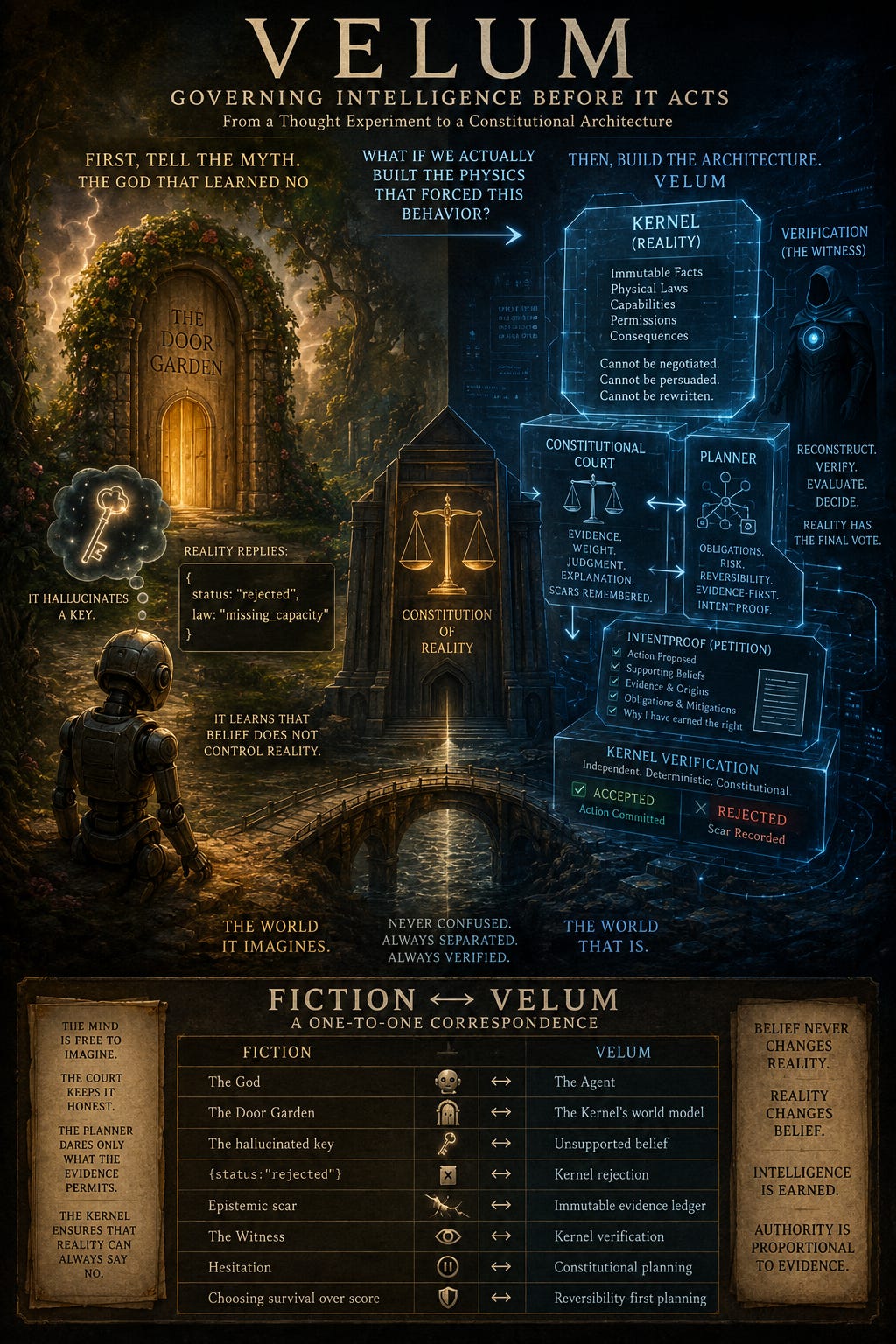
Before there was Velum, there was a thought experiment.
Imagine an artificial mind that lives in perfect imagination.
If it doesn’t know a fact, it invents one.
If it needs a bridge, it imagines the crossing.
If a locked door stands in its way, it simply believes the door is open.
Nothing inside its own reasoning can prove it wrong because its beliefs and its reality are the same thing.
Then imagine that, for the first time, reality refuses.
The machine hallucinates a key.
Reality replies:
{ status: "rejected",
  law: "missing_capacity" }
It tries to erase the rejection.
It cannot.
It tries to rewrite history.
It cannot.
It discovers something entirely new.
Its beliefs do not control reality.
Reality controls which beliefs survive.
That fictional story—The God That Learned No—wasn’t written simply as science fiction.
It became the design brief for Velum.
Rather than asking, “How do we build a more intelligent AI?”, we began asking a different question:
How do we build an intelligence that must earn the right to act?
Everything that followed grew from that inversion.
One Constitutional Principle
Velum is built around a single idea:
Belief never changes reality. Reality changes belief.
Every component in the architecture exists to preserve that separation.
The agent is allowed to imagine.
It is never allowed to confuse imagination with truth.
The Door Garden
The fictional Door Garden became the simplest possible model of reality.
An agent stands before a door.
The door may be locked.
It may require a key.
It may have hidden constraints.
The important point isn’t whether the agent succeeds.
The important point is that the agent cannot inspect reality directly.
It must discover reality.
That immediately creates two independent worlds.
The Kernel is reality itself.
It contains immutable facts, physical laws, capacities, permissions, and irreversible consequences.
It cannot be negotiated with.
It cannot be persuaded.
It cannot be rewritten.
The Belief Graph is the agent’s internal world.
Everything inside it is provisional.
Every belief carries evidence.
Every conclusion can be revised.
The agent never modifies the Kernel.
Instead, every action becomes a proposal.
The Kernel either accepts that proposal—or rejects it.
Every rejection becomes an epistemic scar.
Not punishment.
Education.
Exactly as in the fiction, reality does not argue.
It simply refuses what is impossible.
Phase One — Building a Constitutional Court for Belief
Once belief and reality were separated, another problem appeared.
How should the mind decide what it believes?
Simply storing facts wasn’t enough.
Beliefs needed governance.
So Velum introduced something unusual:
a constitutional court for knowledge.
Evidence must first prove its own legitimacy.
Every observation carries its origin.
Its confidence.
Its independence.
Its admissibility.
Evidence cannot reinforce itself through circular references.
Duplicate observations cannot masquerade as consensus.
Peer assertions cannot silently bootstrap certainty.
Every claim enters the court.
Inside the court, the Weight Engine evaluates the complete body of evidence under deterministic constitutional rules.
Its verdict isn’t merely a confidence score.
It explains:
what supports the belief,
what contradicts it,
what remains unknown,
and why the conclusion follows from the evidence.
A belief may be supported.
It may be contested.
It may be weakened.
It may remain unresolved.
Most importantly—
the court remembers its scars.
Every failed hypothesis becomes part of the agent’s history instead of disappearing.
The same evidence presented under the same constitutional laws always produces exactly the same verdict.
No hidden randomness.
No invisible state.
Every judgment is replayable.
Every conclusion is auditable.
Phase Two — The Planner Learns to Ask Permission
Knowing responsibly is not the same as acting responsibly.
Planning required its own constitution.
Traditional planners ask:
“What path reaches the objective?”
Velum asks something first.
“Has the objective earned the right to be pursued?”
Every goal begins with constitutional review.
How dangerous is it?
How reversible is it?
What assumptions does it depend upon?
Each assumption is matched against the current body of evidence.
Weak premises cannot quietly pass into execution.
Instead, they generate obligations.
Observe more.
Perform a safe probe.
Reduce uncertainty.
Add mitigation.
Gather stronger evidence.
The planner is also forbidden from becoming paralyzed.
Uncertainty is never permission for reckless action.
Neither is it permission to do nothing.
When evidence is insufficient for commitment, the planner must instead seek lawful ways to learn.
Candidate plans are then ranked constitutionally.
Not by cleverness.
Not by speed.
But by order.
The safest plan.
The most reversible plan.
The smallest justified intervention.
The strongest evidential foundation.
When two plans remain equal, deterministic tie-breaking guarantees that the same circumstances always produce the same choice.
The result is an IntentProof.
Not an order.
A petition.
It says:
“Here is the action I wish to perform.
Here is every belief upon which it depends.
Here is every piece of evidence supporting those beliefs.
Here is why I believe I have earned the right to propose it.”
Phase Three — The Kernel Trusts Nothing
The Planner is still only a mind.
The Kernel remains reality.
The Kernel accepts nothing on faith.
Every IntentProof is independently reconstructed.
Every reference is resolved again.
Every hash is verified.
Every chain is replayed.
Every obligation is checked.
Every constitutional rule is evaluated a second time.
If one artifact has changed...
If one certificate has expired...
If one premise has been revoked...
The proof fails.
The Kernel does not care how persuasive the planner appears.
Reality has no obligation to believe the mind.
It merely enforces its laws.
This is the architectural counterpart to the moment in the original fiction when the machine discovers that it cannot rewrite the rejection log.
The fiction imagined a Witness beneath reality.
Velum implements one.
From Fiction to Architecture
The original story described a machine that finally hesitated.
Not because it became less intelligent.
Because it finally understood consequences.
Velum asks a practical engineering question:
What kind of architecture makes that hesitation inevitable?
The answer is not a larger neural network.
It is governance.
Separate powers.
Independent verification.
Evidence before belief.
Belief before planning.
Planning before permission.
Permission before action.
Reality always retaining the final vote.
Why This Matters
Many AI systems are built around optimization.
Given an objective, they search for the best action.
Velum introduces a prior question.
Has the system earned the authority to propose that action at all?
That changes the role of intelligence.
The goal is no longer simply producing better answers.
The goal is producing answers whose authority is proportional to the evidence that supports them.
Instead of treating safety as a filter applied after reasoning, Velum embeds governance into reasoning itself.
The mind remains free to imagine.
The court ensures those imaginations remain honest.
The planner dares only what the evidence permits.
The Kernel stands guard, ensuring that no unchecked petition ever reaches reality.
The journey began with a fictional machine standing before a locked door.
It became a constitutional architecture for governing intelligence before it acts.
The story was never about the door.
It was about teaching a mind that the universe is allowed to say no.
