
What is the difference between time and memory?
The space between encountering reality and remembering it.

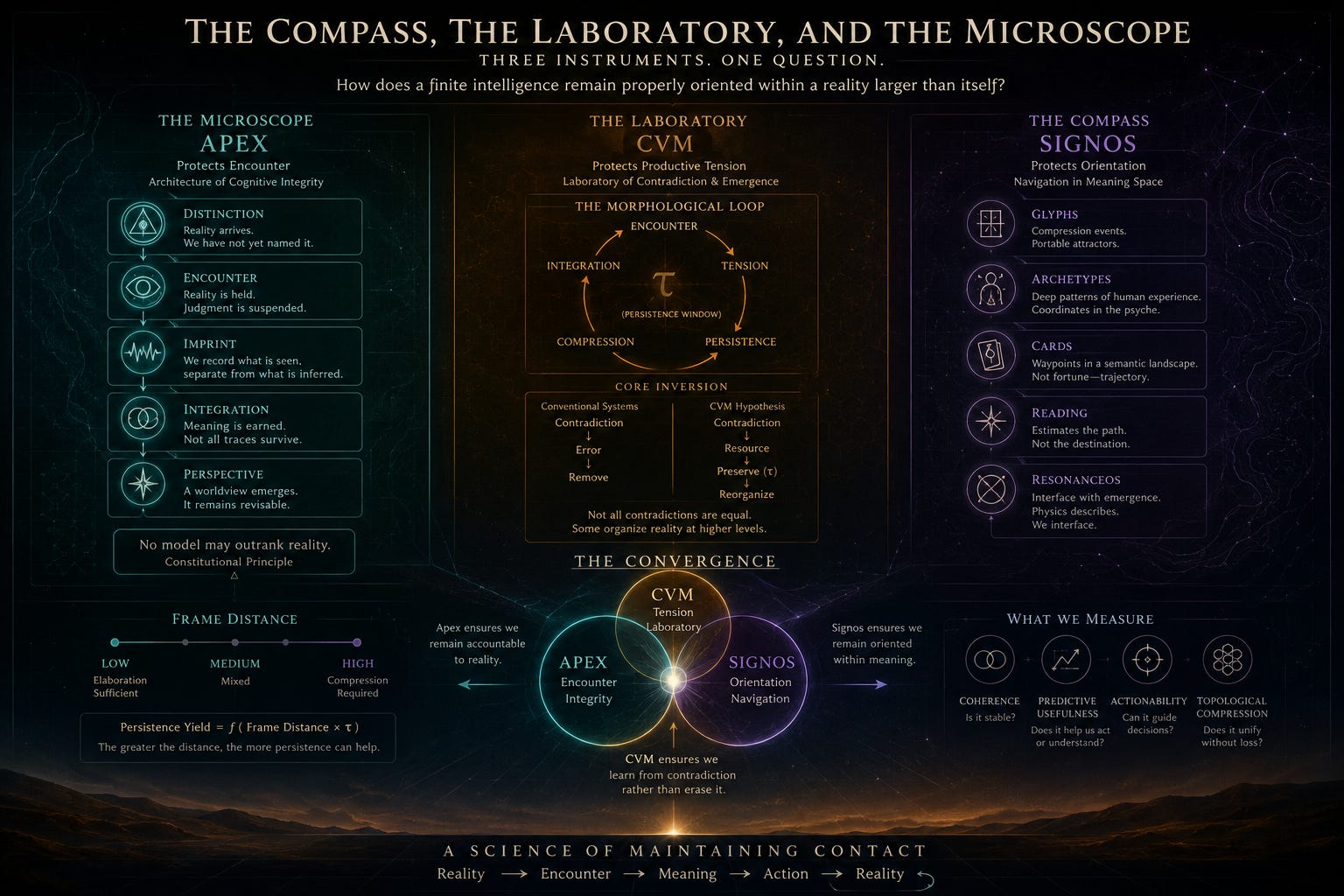
The Compass, The Laboratory, and The Microscope
How Three Different Projects Turned Out to Be Asking the Same Question
This morning began with a dream.
The dream was simple.
What is the difference between time and memory?
At first, it seemed like one of those philosophical questions that appears briefly in the half-light of waking consciousness before dissolving into the day. But instead of fading, it opened a door.
Because the more I followed the question, the more I realized that it wasn’t really about time.
It was about a missing interval.
The space between encountering reality and remembering it.
That realization led somewhere unexpected. It revealed that three projects I had previously considered separate may actually be parts of the same system.
Apex.
CVM.
Signos.
Different language.
Different goals.
Different artifacts.
The same underlying question.
The Hidden Thread
Looking backward across twenty years of work, the visible narrative appears fragmented.
Metadata.
Digital Asset Management.
Knowledge systems.
Archetypes.
Dreams.
Glyphs.
AI.
Semantic criticality.
Contradiction mapping.
Cognitive architectures.
An outside observer might reasonably conclude that these are unrelated interests connected only by curiosity.
The deeper pattern looks different.
Each project was wrestling with the same challenge:
How does an intelligence remain properly oriented within a reality larger than itself?
Everything else appears to be a variation of that question.
Metadata was navigation through information.
DAM was navigation through assets.
Signos became navigation through meaning.
CVM became navigation through emergence.
Apex became navigation between memory and reality.
The subject changed.
The structure remained.
The Microscope
Apex emerged from a simple concern.
Modern artificial intelligence systems are optimized for memory, prediction, and action.
They are extraordinarily capable.
They are also increasingly vulnerable to hallucination.
The deeper problem may not be hallucination itself.
The deeper problem may be that modern systems compress the distance between observation and memory to nearly zero.
Reality arrives.
Memory answers.
The encounter never truly occurs.
Apex proposes a different architecture.
Distinction.
Encounter.
Imprint.
Integration.
Perspective.
The purpose is not to create a system that knows more.
The purpose is to create a system that remains capable of being changed by what it encounters.
In this sense, Apex functions like a microscope.
It allows us to inspect the anatomy of cognition itself.
The Laboratory
Once encounter was preserved, a new question emerged.
What happens when reality contradicts itself?
Most systems treat contradiction as an error.
Resolve it.
Eliminate it.
Move on.
The CVM experiments asked a different question:
What happens if contradiction persists?
The original hypothesis was simple.
Persistence would outperform reflection.
The first pilot immediately challenged that assumption.
Reflection proved to be a strong baseline.
But something more interesting appeared.
Persistence did not necessarily generate better explanations.
It appeared to generate different geometries.
Reflection elaborated.
Persistence reorganized.
The question shifted.
No longer:
“Does persistence work?”
Instead:
“When does contradiction contain information that cannot be accessed through immediate resolution?”
The laboratory was born.
The Compass
Long before either Apex or CVM existed, another thread kept returning.
Symbols.
Archetypes.
Dreams.
Glyphs.
Signos.
For years I treated these as separate interests.
Now they appear differently.
A glyph is not a theory.
A glyph is a compression event.
A portable attractor.
A navigational coordinate within a semantic landscape.
Signos was never fundamentally about divination.
It was about orientation.
How do we navigate spaces too large to fully model?
In retrospect, it was solving the same problem as Apex and CVM from the opposite direction.
Apex studies how reality enters cognition.
CVM studies what happens when cognition encounters contradiction.
Signos studies how cognition maintains orientation.
The microscope.
The laboratory.
The compass.
The Convergence
The surprising realization is that these are not three projects.
They are three instruments.
Apex protects encounter.
CVM protects productive tension.
Signos protects orientation.
Together they form a larger research program.
Not a theory of artificial intelligence.
Not a philosophy.
Not a symbolic system.
A study of how finite intelligences remain connected to realities larger than themselves.
The Constitutional Principle
As the architecture developed, one sentence repeatedly returned.
No model may outrank reality.
That principle now appears to unify the entire stack.
Reality has the right to be encountered before it is interpreted.
Contradictions have the right to persist before they are resolved.
Meaning has the right to emerge before it is compressed.
Orientation has the right to be updated when reality changes.
The purpose is not certainty.
The purpose is contact.
The New Build
This is where the next phase begins.
Not another theory.
Not another framework.
A build.
The Apex simulator.
The CVM laboratory.
The Signos navigation layer.
Three instruments sharing a common substrate.
The microscope.
The laboratory.
The compass.
All investigating the same question:
How does a finite intelligence remain properly oriented within an infinite field?
The next meaningful signal will not come from another model.
It will come from the terrain.
The next anomaly.
The next contradiction.
The next encounter.
That is where the field begins answering back.
Hi Mark, I love your question - what is the difference between time and memory?
I’ve been looking into the work of Rovelli and Culbertson in the interest of exploring this. Thank you for the article, I look forward seeing what you build 🙂